
Why Won’t My Garage Door Open? Common Causes and Fixes
You press the remote, wait for the familiar sound, and nothing happens. Perhaps the motor hums without moving the door, or the door rises a few inches before stopping. Either way, a garage door that will not open can quickly disrupt your plans.
Common causes include a dead remote battery, interrupted power, an engaged lock, a disconnected opener, or damaged lifting components. Some problems involve straightforward checks. Others require a technician because the door’s weight and spring tension make further testing unsafe.
Love Garage Doors, LLC helps Wichita homeowners identify garage door problems and determine the appropriate repair. This guide explains what different symptoms can mean, what you can safely check, and when to stop troubleshooting.
Start With What Your Garage Door Is Doing
Before pressing the button again, look and listen from a safe position. The opener’s response provides useful clues, although no single symptom confirms the diagnosis.
| What you notice | Possible explanation | Appropriate next step |
| No response from the remote, but the wall button works | Remote battery, programming, or lock mode | Check the remote and manufacturer’s instructions. |
| Neither control works, and the opener appears unpowered | Interrupted electrical supply | Check accessible power controls without opening electrical equipment. |
| Motor runs, but the door stays closed | Disconnected carriage or drive-system fault | Check whether the emergency release was previously used. |
| Door rises a few inches and stops | Broken spring, binding, or another operating fault | Stop using the opener and arrange an inspection. |
| Door looks crooked, or a cable hangs loose | Lifting-system or track problem | Keep clear and request professional service. |
If you see damaged components, hear grinding, or notice the door lifting unevenly, do not keep cycling the opener. Repeated attempts will not resolve the underlying problem.
1. The Remote Battery or Programming Needs Attention
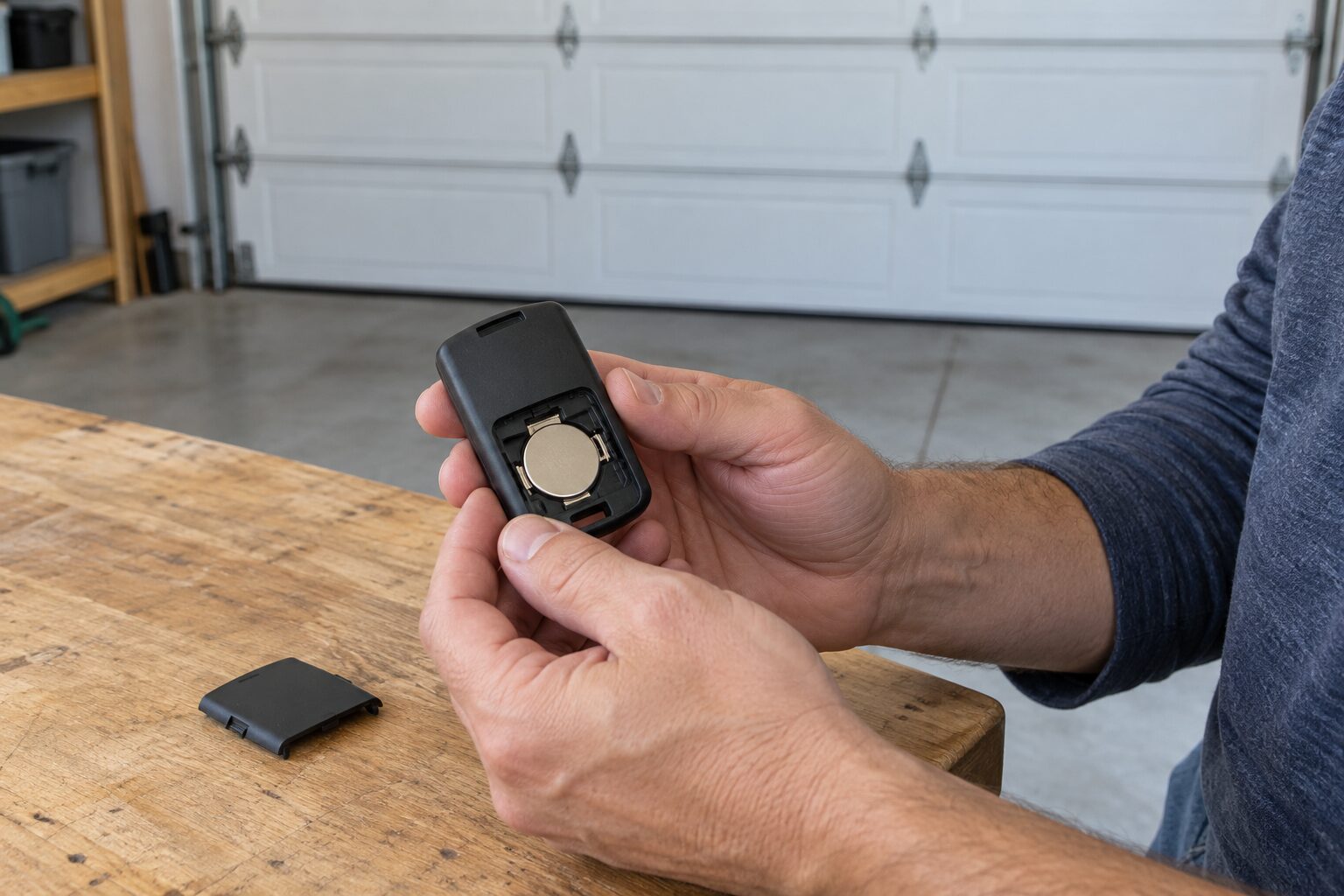
If the door operates normally from the wall button but does not respond to the handheld remote, start with the remote.
Chamberlain’s remote-control troubleshooting guidance specifically separates this situation from a door that will not operate through either control.
What you can check
Replace the battery with the type specified for your remote, checking its orientation. Examine the case and buttons for visible damage, and try a second programmed remote if you have one.
If a replacement battery does not help, consult the opener’s manual about programming. Use instructions for your exact model rather than a generic reset procedure.
Avoid erasing the opener’s entire memory as your first step. That may disconnect other remotes, keypads, or vehicle controls that were working correctly.
When the wall control also fails, expand the investigation beyond the remote. Buying another remote will not correct a power interruption or mechanical problem.
2. The Garage Door Opener Has Lost Power
An opener needs a working power supply unless it has an operational battery-backup system. An unplugged power cord, switched-off outlet, or tripped protective device can leave the door unresponsive.
Genie’s garage door opener troubleshooting guide includes checking the power source when the opener will not run.
What you can check
Look for signs of a wider outage. Are the garage lights and other nearby electrical devices working?
Check whether an accessible wall switch controls the opener’s outlet. If the plug is visible, confirm that it has not been disconnected. Do not climb on a vehicle or unstable furniture to reach an overhead outlet.
If a breaker or ground-fault circuit interrupter has tripped, follow its operating instructions. Do not repeatedly reset a device that trips again. Recurring trips, burning smells, damaged cords, or signs of moisture require professional attention.
An opener light that does not illuminate is a clue, not proof that the unit has no power. The bulb or lighting component could have its own fault.
3. Lock Mode or a Door Lock Is Preventing Operation
Two different types of locks can affect garage door operation: the opener’s control lock and a physical lock on the door.
Check the wall control’s lock mode
Some wall controls have a lock or vacation setting that disables handheld remotes while allowing operation from the wall control.
Chamberlain explains that a flashing control light or a displayed lock-mode message can indicate this setting on certain models. Follow your manual to turn it off, because controls and indicator patterns vary.
Look for an engaged physical lock
A manually engaged slide lock can physically prevent the door from opening. Some systems also have an automatic powered lock.
If you can clearly identify a manual lock and know how it operates, check it while the door is fully closed and the opener is not running. Do not force an unfamiliar mechanism or remove hardware.
Genie’s opener safety guidance addresses disabling conventional door locks when installing an automatic opener. Ask a technician how your particular locking arrangement should function.
Never keep activating the opener against a locked door.
4. The Door Has Been Disconnected From the Opener
If the motor runs but the door does not move, the door may have been disconnected using the emergency release.
On many overhead openers, a moving carriage connects the drive mechanism to the door. Releasing that connection allows manual operation when appropriate.
Genie’s guidance on an opener running without moving the door identifies a disconnected carriage as one possible explanation. It also states that reconnection procedures depend on the model.
What you can check
Consider whether someone recently used the emergency release during a power outage or service visit.
If the door is fully closed, appears undamaged, and was deliberately disconnected, consult the manual’s reconnection instructions. Keep everyone clear of the opening and moving parts.
Do not pull the release cord simply to experiment with a door that is stuck, crooked, or partly open. If reconnection does not restore normal operation, the drive mechanism may need inspection.
5. A Spring or Cable Has Failed
Garage door springs help balance the door’s weight. A broken spring can prevent the opener from lifting the door or cause it to rise only slightly before stopping.
Clopay’s repair guidance lists a door opening only a few inches as a possible sign of a broken spring. A visible gap in an exposed torsion spring is another warning sign.
Signs that require professional attention
Stop using the system if you notice:
- A loud bang followed by failure to open.
- A visible separation in a spring.
- A loose, frayed, or displaced lifting cable.
- One side of the door rising differently from the other.
- An opener straining against a door that barely moves.
Do not attempt to wind springs, reposition cables, or loosen bottom brackets. These components can remain under substantial tension.
The Door & Access Systems Manufacturers Association’s safety guidance recommends trained technicians for spring-system repairs and worn cable replacement.
For a suspected spring or cable fault, arrange Garage Door Repair and leave the door unused until it has been assessed
6. The Door Is Binding, Obstructed, or Frozen Shut
Sometimes the opener receives the command, but the door cannot move freely. A damaged track, displaced roller, physical obstruction, or frozen bottom seal can interfere with opening.
For Wichita homeowners, freezing conditions can make moisture beneath the bottom seal relevant. Clopay discusses frozen seals and other seasonal operating problems in its cold-weather troubleshooting guide.
What you can check
From a safe position, look for objects pressing against the door or blocking its path. Remove loose items only when they are safely accessible and away from components under tension.
If ice is holding the bottom seal to the floor, stop trying the opener. Do not pry the door upward, chip aggressively around the seal, or use an open flame. Follow the door manufacturer’s guidance or request help if the seal remains stuck.
Bent tracks, rollers outside their tracks, or visibly buckled panels need professional assessment. Do not hammer tracks into position or loosen their mounting brackets.
Also, avoid assuming the photoelectric safety sensors explain an opening failure. These sensors normally prevent or reverse closing when their beam is interrupted; a door that will not open requires a broader diagnosis.
7. The Opener’s Drive System or Electronics Need Repair
When power and controls appear normal, an internal opener fault may be responsible.
A motor that runs without moving the door can indicate a drive-component problem as well as a disconnected carriage. Genie’s troubleshooting guidance describes model-specific carriage and coupler faults, illustrating why the motor sound alone cannot identify the failed part.
Record any error code or flashing-light pattern before contacting a technician. Mention whether the motor hums, runs continuously, stops quickly, or makes a new noise.
Do not remove the motor housing or increase force settings to make the opener overcome resistance. The door’s mechanical condition should be checked before assuming the motor needs replacement.
If the problem is limited to the opener, the existing door may remain suitable. Garage Door Replacement becomes a separate consideration when the door also has substantial damage or deterioration. If a new door is appropriate, discuss compatible hardware and opener requirements as part of Garage Door Installation.
Can You Open the Garage Door Manually?
Manual opening may be appropriate during a power outage when the door is mechanically sound. It is not a suitable workaround for a suspected broken spring, damaged cable, or off-track door.
Consult the instructions for your exact opener before using its emergency release. Do not disconnect an open or partly open door when its balance or condition is uncertain.
Chamberlain’s manual-operation guidance says to stop and contact a professional if the door feels unusually heavy, will not stay open, or slams shut.
Never use the release cord as a lifting handle, force a resistant door, or ask someone to stand underneath it while you troubleshoot.
If your vehicle is trapped or the door is stuck in an unsafe position, contact Love Garage Doors about a Garage Door Emergency. Describe the door’s position and any visible damage so the technician understands the situation.
Get Help With a Garage Door That Won’t Open in Wichita
A garage door that will not open may need something as simple as a remote battery or a control-setting correction. However, limited movement, unusual weight, loose cables, and uneven lifting call for professional diagnosis.
Love Garage Doors, LLC is a full-service Garage Door Company serving Wichita, KS. Whether the issue involves the controls, opener, or door hardware, an inspection can help identify the cause and the appropriate next step.
Visit lovegaragedoors.com to request service and get help restoring safe, dependable access to your garage.